|
TUSTIN, CALIFORNIA
JANUARY 22, 1999
A new method
to field terminate multimode fiber optic ribbon cable has
been developed for military and aerospace environments. As
the demand for broadband fiber optic capability continues
to grow there remains a need to easily splice and connect
multifiber cable in the field. The current world of epoxy
and fiber polished products yield good results in the factory
with complex tools and highly skilled technicians. However,
the results become less reliable out in the field with untrained
installers.
Now a new technology allows anyone to connect multimode ribbon cable
with a simple tool and no previous optical cable experience. This technology
centers around a means of focusing light between opposing fibers with
an array of miniature diffractive lenses. These lenses have been coated
onto a glass substrate that is positioned in a connector or splice between
the fibers. The light exiting each fiber is captured by a lens and focused
to the center of the corresponding fiber.
Difficulties in Connecting Fibers
To understand how this microlens array works, let's first back up and
review the difficulties in connecting optical fibers. When one considers
that a typical fiber core is 100 microns or approximately .004 inches
in diameter, it is easy to see how a .001 inch misalignment or offset
of the fibers can lead to substantial loss of light. When you take into
account angular misalignment of fibers, manufacturing tolerances of the
fiber itself such as core to cladding concentricity and circularity,
there is plenty of opportunity for attenuation of light energy between
fibers. In a multifiber ribbon cable you can multiply the magnitude of
the problem by the number of fibers.
Physics dictates that light traveling between fiber and air is refracted
due to the different indexes of refraction between glass (or plastic)
and air. This simple law of nature can not be violated and is a major
source of consternation to all connector designers today. The rapidly
expanding cone of light exiting a fiber must be captured and transmitted
to the opposing fiber.
Commercial connector manufactures have gone to polishing the endface
of the fibers in a convex shape to permit physical contact between fibers.
This physical contact increases light transmission through the interface
and also reduces backscattering. In the harsher aerospace and military
environment, physical fiber to fiber contact is not permitted. The constant
vibration and shock scratches the fiber endfaces and quickly degrades
optical performance.
Principles of Microlens Operation
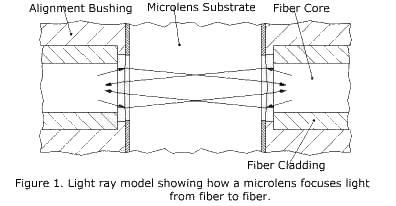
In this new interconnect, the diffractive microlens with antireflective
coating captures the cone of light exiting a fiber (see figure 1). The
light is then focused to the center of the opposing fiber. This focusing
of light energy is a step forward in technology as it accommodates the
main variables in today’s connectors. It compensates for the manufacturing
tolerances in components and the imperfections in the fiber by diffracting
the light to the center of the fiber core.
As there is a lens coated on both sides of the microlens substrate the
light can be focused in either direction (see figure 1). Because the
lenses are coated directly on the substrate there are no Fresnel reflections
between the lenses. The substrate also serves to standardize the focal
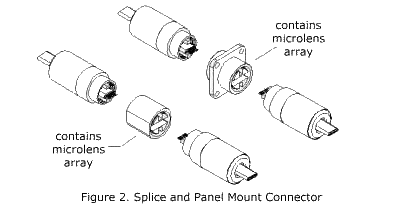
length between lenses. The microlens substrate is typically supplied
in the receptacle or box mounted side of the connector. In a splice it
is the center component between two identical plugs (see figure 2).
Diffractive Microlens Optics
The burgeoning science of diffractive optics for microlens arrays is
being studied at universities and companies around the world. By fabricating
microminiature lenses on optical substrates, new and useful light patterns
can be generated. Lenses less than one micron in diameter can focus,
collimate, and manipulate light to the designer's fancy. For example,
arrays are being used to intensify the light of individual pixels on
everything from LCDs to photocopying machines. Rudimentary microprocessor
chips have been made that operate on light energy rather than electric
current.
These microlens arrays are nothing more than a controlled coating of
ions deposited onto a substrate in a vacuum. An advantage for multifiber
cable is the cost in that batch style manufacture means 12 or 18 channel
lens substrates are little more expense than a single lens substrate.
Another asset for fiber connection is the extreme submicron accuracy
and consistency in which these microlenses can be manufactured.
Connectors and Splices
This microlens technology must be packaged in an efficient and easy to
use product to be of value to the world of fiber optics. To this end,
eighteen channel connectors and splices have been created for aerospace
and military applications. These interconnects can be installed onto
multifiber cable in less than one minute by a technician with a simple
strip and cleave tool and no previous optical fiber experience.
A tool to strip and cleave ribbon cable on standard 250 micron centers
was developed by an aerospace firm to be used in conjunction with these
products. This tool is set at the factory for the size and number of
fibers in the cable. Through a unique cleaving action the endface of
the fiber achieves a near polish finish.
After preparation of the cable the installer simply inserts the fibers
into an alignment bushing in the connector receptacle or splice body.
A coupling nut is tightened to clamp and seal* around the cable. This
process is repeated for the opposing cable. No special assembly or polishing
tools are needed. The result is a sealed termination of eighteen fibers
with an insertion loss of 0.5 dB maximum that can withstand the environmental
requirements of military circular connectors.
This method of terminating ribbon cable eliminates the laborious and
time consuming procedures of traditional epoxy and polish interconnects.
It permits anyone to splice and connect fiber optic cable out in the
field without previous experience or cumbersome equipment. This microlens
technology is a step forward in the quest for a user friendly conversion
to the world of fiber optics.
*patent pending for clamp and seal device
SPEC SHEET:
End Applications: Aircraft and military broad bandwidth equipment; imagery
and communication devices for harsh environments
Related Products: Fiber optic ribbon cable connectors and splices.
Main Points: Ribbon cable splicing and interconnects can be reliably
installed in the field with a technology that eliminates:
-fiber polishing
-epoxy and adhesives
-special assembly tools
-need for skilled installers
-need for laboratory setting
This text is a reprint of the article: Microlens Multifiber Interconnect
Technology in the January edition of Connector Specifier.
|